 |
History
The Prince of Wales Museum was built in order to honor and commemorate the visit of King George V to India. Although the idea for a museum was initiated in 1904, the foundation stone was laid down by the Prince of Wales in 1905. In 1907, the government of Bombay (Mumbai) Presidency granted the museum committee a strip of land called the ‘Crescent Site’. The Prince of Wales Museum was designed by a prominent architect, George Wittet and was erected on this site in 1915. Initially the museum was used as a military hospital and a ‘Children’s Welfare Center’ during the ‘First World War’. The museum was inaugurated in 1922.
Architecture
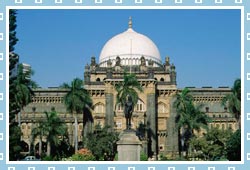
The Prince of Wales Museum is one of Mumbai’s prized, British Raj era structures. The museum is built in the Indi-Saracenic style of architecture. The design of the building is a blend of 15th to 16th century Gujarati and Islamic design, in addition to English brickwork. The structure is adorned with an impressive Mughal white dome that adds splendor to its appearance. The building is bordered by lavish green gardens. The museum has three different parts for Natural history section, Archaeology section and Art section.
Museum Artifacts
Innumerable forms of art and artifacts hailing from India, Tibet, Nepal and other far eastern countries are preserved in this museum. The museum also houses a collection of 2000 rare miniature paintings from several noteworthy art schools in India. Ancient Indian art and sculptures are exhibited in the museum’s sculpture gallery. One can also find decorative artworks made from wood, metal, jade and ivory among the museum collections. There are also rare archeological artifacts that date back to the ‘Indus Valley’ civilization in the 2000 B.C. Remnants from the ‘Maurya’ as well as ‘Gupta’ periods are beautifully displayed in the museum. The ‘Natural History’ section of the museum includes a collection of reptiles, mammals, amphibians, birds and fishes. There is another section that displays Indian arms and armor that displays an array of weapons, swords, shields in addition to other projectiles. The museum has a section comprised of European oil paintings.
The Prince of Wales Museum was built in the 20th century and was designed in the Indo-Saracenic style by George Wittet. This museum houses a collection of rare ancient artworks and sculptures of India and far-Eastern countries. A treasured structure in Mumbai, the architecture and artifacts of the Prince of Wales Museum will leave tourists awe-struck by its magnificence.